Fake identities are becoming harder to detect — and harder to stop.
What appears to be a valid identity is no longer a reliable signal of trust.
A passport is presented at a border checkpoint. At first glance, it looks genuine. The layout is correct. The photograph appears authentic. The personal data matches the traveler presenting it.
But subtle details have been manipulated.
The differences are difficult to detect with the human eye, especially in environments where border officers are processing high volumes of passengers in limited time. Situations like this are becoming more common.
AI-assisted tools can now generate convincing identity documents, manipulate images and support synthetic identity creation at scale. At the same time, border agencies, airports and other high-assurance environments are under pressure to process growing passenger and migration volumes quickly while maintaining strict security and compliance standards.
Many verification processes were designed for a lower-risk environment. Today, they are being tested by higher volumes, more sophisticated fraud techniques and increasing operational pressure. Put simply, visual inspection alone is not enough.
High-assurance identity verification refers to the use of structured, technology-driven processes to confirm that an identity is genuine, consistent and can withstand scrutiny in high-risk, high-volume environments, typically combining document authentication, data validation and auditability.
As border environments and other high-assurance environments such as banking and hospitality increasingly combine physical documents, digital credentials and automated processing, identity verification is becoming a system-design challenge rather than a single checkpoint activity.
Why Fake Identity Risk Is Rising
Several forces are driving this shift.
First, document forgery has become easier to commit. High-quality templates, editing tools and AI-generated images make it harder for the human eye to detect fraudulent IDs.
Second, synthetic identities are becoming more common. These combine real and fabricated data to create identities that can pass basic checks but fail under deeper scrutiny.
Third, remote verification workflows introduce new vulnerabilities. Without physical interaction, organizations rely heavily on image capture, document uploads and automated checks. These can be exploited where image quality is poor or verification processes are inconsistent.
Together, these trends are increasing both the likelihood of fraud and the difficulty of detecting it using traditional methods — particularly in high-assurance identity verification environments where consistency and reliability are critical.
This is reflected in online search behavior as well. Users are actively searching for terms such as “ID scanner,” and “can scanners detect fake IDs,” indicating growing concern around identity fraud and verification reliability across sectors.
At the same time, many organizations are still relying on verification approaches designed for slower-moving, lower-volume environments. This mismatch is exposing the limits of manual inspection and inconsistent verification processes.
Why Visual Inspection Is No Longer Enough
As fraud techniques become more sophisticated, the limitations of manual inspection are becoming more visible — especially where consistent, auditable identity verification is required.
Identity verification may still rely on a person looking at a document and making a judgment.
That approach is under pressure for several reasons:
- Human inspection is inconsistent, especially under time pressure
- Document formats vary widely across countries and regions
- Security features are increasingly complex and difficult to verify visually
- High passenger and traveler volumes reduce the time available for careful checks
- Border and immigration workflows increasingly involve automated and self-service processing
Even experienced staff can miss subtle signs of manipulation, particularly when documents are designed to pass a quick visual check.
At the same time, expectations are increasing. Organizations are expected to demonstrate not only that they checked an identity, but how they checked it, what data was captured and whether the process can be audited. This is where manual processes begin to break down.
To manage growing volumes while maintaining assurance, organizations increasingly need technologies that support more structured, repeatable and auditable verification workflows — a core requirement of high-assurance identity verification.
What Modern ID Scanners Actually Do
ID scanners, also referred to as ID document readers, help organizations move from manual inspection to structured, technology-driven verification.
Rather than relying on a quick visual check, modern systems support more consistent identity verification across high-volume and high-assurance environments.
ID document readers support high-assurance identity verification by:
- More reliable document authentication
- Faster and more consistent data capture
- Improved throughput in operational environments
- Better auditability and recordkeeping
- Stronger support for automated and self-service workflows
- More structured verification across physical and digital credentials
To enable this, modern ID scanners may combine technologies such as:
- High-resolution image capture
- MRZ (machine-readable zone) reading
- Barcode parsing
- RFID chip reading
- Ultraviolet and infrared illumination
- Authentication software integration
These capabilities enable organizations to move from subjective judgment to structured, repeatable verification outcomes that are more consistent, auditable and scalable.
High-quality image capture is critical because authentication decisions are only as reliable as the data collected. Better images support stronger document analysis, more consistent verification and more reliable audit records. High-resolution ID scanners such as the ATOM 3K are designed to capture the level of detail required for these high-assurance verification processes.
Beyond traditional document alteration and counterfeiting, some attacks now target the contactless chips embedded in modern travel and identity documents. While these attacks remain relatively uncommon, authentication processes can help identify attempts to alter, clone or manipulate chip data. Technologies such as passive authentication, active authentication and secure access controls help verification systems confirm that chip contents are genuine and have not been tampered with — even when visual inspection appears normal.
As industry experts have noted, contactless chip fraud is an emerging threat that underscores the importance of integrating document imaging, chip validation and authentication into a broader identity verification process.
In border control environments, this is especially important. Verification systems must support high throughput while maintaining consistency, auditability and confidence in the result.
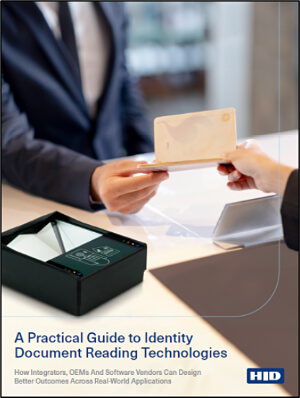
For a deeper look at how ID document readers work and the technologies involved, see our guide.
Together, these capabilities enable a critical shift: from subjective checks to a reliable, auditable digital record of identity verification.
This creates a consistent electronic record of each verification decision, instead of relying on visual checks, allowing organizations to capture, store and audit identity data consistently across systems and locations.
Where High-Assurance Identity Verification Matters Most
High-assurance identity verification is critical in environments where risk, compliance and throughput intersect. These include:
- Border control and immigration checkpoints
- Airport passenger processing
- Banking and AML-regulated onboarding
- Government services and public sector workflows
- Notarial and legal services
- Hospitality and age verification
- Gaming and regulated access environments
Each of these environments has different requirements. Some prioritize speed and throughput. Others require deeper authentication and auditability. In all cases, verification must remain consistent under operational pressure.
In banking, identity verification forms part of wider AML and KYC programs designed to prevent financial crime and ensure regulatory compliance.
In notarial and legal services, organizations must demonstrate that individuals are who they claim to be before important transactions or documents can be executed.
Government departments increasingly need reliable identity verification when citizens access benefits, public services and other state-funded programs.
Gaming and regulated access environments face similar challenges, balancing customer experience with age verification, compliance and fraud prevention requirements.
What these environments have in common is the need for reliable identity verification that can withstand scrutiny and provide a trusted record of the decision — a defining characteristic of high-assurance identity verification.
Border control remains one of the clearest examples. Immigration and border agencies must process large volumes of travelers quickly while managing increasingly sophisticated fraud techniques, greater document diversity and rising expectations for security and auditability — making it one of the most demanding high-assurance identity verification environments.
As more border environments introduce automated lanes, self-service processing and biometric workflows, identity verification systems need to support both operational efficiency and high assurance. This is driving demand for verification systems that operate consistently at scale.
Why Physical Identity Verification Is Regaining Importance
For several years, the focus in identity verification was on digital and remote workflows.
That is now shifting. As AI-driven fraud increases and remote verification becomes more exposed, in-person identity checks are becoming more valuable again, particularly in border control and other higher-risk environments.
This does not mean a return to manual processes. It means combining physical presence with technology-enabled verification that enables:
- Higher-quality document image capture
- More reliable authentication of physical security features
- Stronger linkage between the person and the document
- Greater confidence in the outcome
In many cases, the most effective approach is not digital or physical, but a combination of both. Organizations increasingly need systems that can handle:
- Physical documents such as passports and national identity cards
- Digital credentials such as mobile driver’s licenses (mDLs)
- Both physical and digital credentials within the same environment
This combined approach is becoming essential for high-assurance identity verification across modern environments.
Designing Verification Systems for Today’s Risk Environment
The key challenge is no longer just detecting fake IDs. It is designing verification processes that work reliably at scale. This requires thinking beyond the device itself.
Effective identity verification systems consider:
- The operational environment (throughput, staffing, deployment model)
- The types of documents and credentials being presented
- The level of assurance required
- How captured data integrates into downstream systems
- How decisions are recorded and audited
- How automated and self-service workflows affect verification reliability
This is why integrators, OEMs and software vendors play such a central role. They are not simply selecting hardware. They are designing systems that balance speed, risk, compliance and user experience across increasingly complex environments.
These system-level decisions ultimately determine whether identity verification is consistent, scalable and capable of meeting high-assurance requirements.
This is particularly relevant in border control, where identity verification often forms part of a wider ecosystem involving document readers, biometrics, authentication software and automated processing infrastructure. In these environments, performance depends not just on individual components, but on how the entire system works together.
As explored in our practical guide to identity document reading technologies, the most effective solutions start with the right diagnostic questions and align technology to real-world requirements — helping integrators and system designers match verification capabilities to operational needs.
Supporting High-Assurance Identity Verification
As identity fraud becomes more sophisticated, verification processes need to evolve.
The challenge is not only detecting fake IDs, but creating systems that deliver consistent, reliable and auditable outcomes across high-assurance environments.
Modern ID scanners are a key part of that shift, enabling organizations to move from manual inspection to structured, technology-driven verification. The most effective identity verification strategies combine document capture, authentication, workflow design and auditability into a single, integrated process designed for high-assurance environments.
Additional Resources