Organizations have invested heavily in protecting the digital workplace. Networks are monitored, applications require authentication and access to sensitive systems depends on verifying that users are who they claim to be. But those protections can only go so far once sensitive information leaves the screen and lands in a printer tray.
Printed documents can contain financial information, employee records, customer data, intellectual property, healthcare information and other confidential material. Yet in many workplaces, a document is released as soon as someone clicks "print," whether or not that person is standing at the printer to retrieve it.
That creates a security gap that is easy to overlook. A document left unattended at a shared printer can be viewed, removed or simply picked up by the wrong person.
Secure printing helps close that gap by requiring users to authenticate before a document is released. More importantly, organizations can extend the trusted identities employees already use throughout the workplace to make that process both secure and familiar.
Why Traditional Printing Creates Security Gaps
The challenge with traditional printing is simple: the person sending the document and the person collecting it are separated by both time and location.
In a shared office, an employee may send a document to a printer down the hall and retrieve it several minutes later. In a healthcare environment, a clinician may print patient information from an exam room to a central printer. Similar situations occur in schools, government offices and other environments where multiple people share printing infrastructure.
During that gap, sensitive information can sit exposed.
Secure print changes the process. Instead of printing immediately, the job remains in a queue until the authorized user authenticates at the printer and releases it. This helps ensure the document is available when the intended recipient is there to collect it.
Authentication itself, however, matters.
PINs require users to remember another code and can be shared. Passwords can be forgotten or disclosed, adding administrative work for IT teams. QR codes can be copied or cloned. A secure print strategy should therefore consider not only whether users authenticate but how their identities are verified.
Bring Trusted Identity to the Printer
For many organizations, the answer may already be in employees' hands or pockets.
A trusted identity is a validated identity associated with a credential such as a badge, smart card, mobile credential, wearable or biometric. Rather than introducing a separate authentication method specifically for printing, organizations can extend these credentials to the printer.
The same credential an employee uses to enter a building, access a smart locker or interact with other workplace systems can also be used to release a sensitive document.
This approach is part of a broader shift toward a connected workplace, where a single employee ID enables seamless access to buildings, devices, and other workplace applications. In practice, this means that one trusted credential can support physical access, time and attendance, smart lockers, meeting room booking, EV charging, secure printing and other everyday interactions.
For users, this results in fewer credentials and authentication methods to manage. For IT and security teams, it creates an opportunity to reduce administrative complexity while maintaining greater control over how employees access workplace resources.
Secure print becomes another part of the identity experience rather than a separate system employees have to learn.
Related: How a Single Mobile Credential Can Transform the Workplace Experience >>
Security Is Only Part of the Value
Protecting confidential documents may be the primary reason to implement secure printing, but holding print jobs until an authorized user releases them can address several other workplace challenges.
It can support privacy and regulatory compliance initiatives by providing greater control over access to documents containing sensitive information. It can also reduce unnecessary printing because forgotten or unwanted jobs are not automatically printed and left behind.
Better user identification can improve print tracking and accountability as well. When organizations can associate printing activity with an authenticated identity, they gain more accurate information for monitoring usage and allocating costs.
The result is a secure print strategy that can contribute to security, operational efficiency and sustainability at the same time.
Start With the Right Credential Strategy
A successful secure print deployment begins with an important question: How should users authenticate?
There is no single credential that is right for every organization. The appropriate choice depends on existing infrastructure, security requirements, user expectations and plans for the future.
Smart cards can provide strong security for organizations that already rely on cards or badges throughout the workplace. Modern smart card technologies are designed to provide greater protection against cloning than legacy proximity credentials, making them well-suited to organizations looking to strengthen identity security across multiple applications.
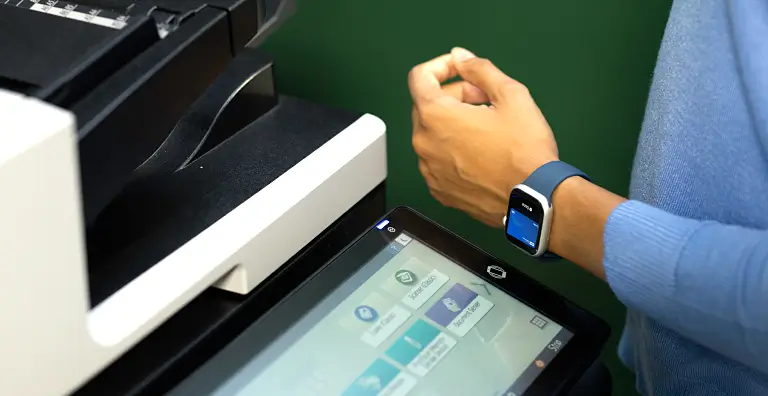
Mobile credentials and wearables give organizations another way to extend trusted identity to printing. They can support digital workplace initiatives while giving users the convenience of authenticating with a device they already carry. They can also make credential deployment and management easier as organizations move toward more mobile workplace experiences.
Organizations do not necessarily have to commit to a single approach across every user or location. The more important goal is developing a credential strategy that supports today's requirements without limiting what the organization can adopt tomorrow.
The Reader Matters Just as Much as the Credential
Choosing a credential is only one half of the secure print equation. The reader at the printer must be able to authenticate that credential reliably and support the experience the organization wants to provide.
That makes reader selection an important part of deployment planning.
Organizations should consider how employees will interact with the printer. Should they tap a credential to release a job or would hands-free authentication make more sense? Does the reader need to be embedded within the printer or can it be installed externally? Will every employee use the same credential technology or does the environment need to accommodate multiple credential types?
Future requirements matter too.
An organization may rely primarily on physical cards today but plan to introduce mobile credentials over time. Selecting readers that support multiple credential technologies can make that transition easier without requiring the entire secure print infrastructure to be replaced.
Interoperability is especially important for larger organizations with different locations, printer fleets or credential technologies. Readers that can support evolving identity requirements give organizations greater flexibility as their workplace and security strategies change.
In other words, the right reader should solve today's authentication challenge without creating tomorrow's technology limitation.
Building a Secure Print Strategy for the Long Term
Secure printing touches multiple parts of the workplace technology environment, so planning should begin before readers are selected or printers are configured.
Printer manufacturers, managed print providers and identity experts can help organizations evaluate how credentials, readers and printer infrastructure need to work together. Bringing these stakeholders into the process early can help identify compatibility requirements, deployment considerations and future technology needs before they become costly obstacles.
Organizations should also look beyond the immediate printing project. If employees already use trusted identities for physical access or other workplace applications, secure print can become an extension of that existing identity strategy.
That broader perspective can influence decisions about credentials and readers. Instead of asking only, "What will work with our printers today?" organizations can ask, "How should people authenticate across our workplace now and in the future?" That is a much more valuable question.
Secure Print as a Building Block of the Connected Workplace
Workplace security is highly connected. Organizations want to strengthen protection without asking employees to manage a growing collection of cards, passwords, PINs and separate authentication experiences.
Secure printing offers an opportunity to bring the same trusted identity used elsewhere in the workplace to an area that has historically been easy to overlook.
By extending cards, mobile credentials, wearables and biometrics to secure print, organizations can help protect sensitive information, reduce unnecessary printing and create a more consistent experience for employees. Choosing readers that can support both current and future credential technologies can further extend the value of that investment.
The printer may be only one touchpoint, but it is part of a much bigger picture. When trusted identity follows the user across physical and digital workplace experiences, secure print becomes another building block in a more connected, secure workplace.
Ready to strengthen your secure print strategy? Read the Implementing Secure Print white paper for guidance on choosing credentials and readers that support your security requirements, user experience and long-term identity strategy.