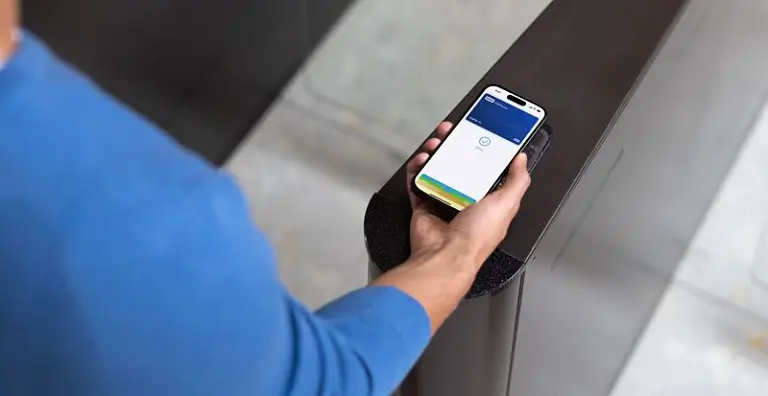
For decades, the employee badge has been a symbol of workplace identity. It opened doors, granted access to secure areas, and identified employees as they moved throughout a building. But today's workplace looks very different than it did even five years ago. Employees split their time between home and the office, collaborate across multiple locations, and rely on digital tools just as much as physical spaces to get work done.
As the workplace has evolved, so has the way we think about identity.
Instead of carrying separate credentials for different tasks — a badge for the building, a password for workstations, another login for printers and additional apps for workplace services — organizations are moving toward a more connected approach. Mobile credentials are the foundation of this shift, allowing employees to use a single, secure identity across the many interactions that make up their workday.
The result isn't simply replacing a plastic badge with a smartphone. It's creating a workplace where identity becomes seamless, secure and connected from the moment an employee arrives until they leave for the day.
The Workplace Has Become an Ecosystem
Modern workplaces are no longer defined by a single entrance or a fixed desk.
Employees may begin their day by entering a parking garage, passing through a lobby, accessing an elevator, reserving a workspace and logging into their computer. Maybe they collect documents from a secure printer, store personal belongings in a locker and attend meetings in multiple locations. Throughout that journey, they interact with dozens of systems that traditionally operated independently.
Each of those interactions often requires its own authentication method.
This fragmented experience creates unnecessary friction for employees while increasing administrative complexity for IT, security and facilities teams. Every additional badge, password, PIN or access system introduces another credential to manage, another process to maintain and another potential security gap.
Mobile identity changes that equation by creating one trusted credential that follows users throughout their entire workplace journey.
Rather than thinking about access as a series of disconnected events, organizations can begin viewing identity as a layer that connects every physical and digital touchpoint.
More Than Opening Doors
When many people hear "mobile credentials," they immediately think about replacing a badge at the front entrance. While building access remains an important use case, it's only the beginning.
A mobile credential can support authentication across the entire workplace, creating a consistent experience wherever identity verification is required. Instead of relying on separate badges, passwords, PINs and workplace apps, employees can use a single trusted identity to securely access buildings, workstations, printers, lockers, desk booking systems and other workplace services. This unified approach simplifies everyday interactions while giving organizations a more flexible and scalable foundation for managing identity across both physical and digital environments.
As organizations continue investing in smart buildings and connected workplace technologies, this unified identity becomes increasingly valuable. Rather than introducing another isolated system, mobile credentials can help connect the technologies that already exist.
Related: How One Mobile Credential Can Transform the Workplace Experience >>
Familiar Technology, New Possibilities
One reason mobile credentials are gaining momentum is that they build on behavior people already understand.
Consumers have grown comfortable storing payment cards, boarding passes, tickets and loyalty cards on their smartphones. Presenting a phone at a reader has become second nature. Extending that same interaction into the workplace feels natural.
Employees don't need to learn an entirely new process or carry yet another device. Their credential is already with them — on the smartphone they use throughout the day.
This familiarity can accelerate adoption while reducing the friction that often accompanies new workplace technology. The experience remains simple: tap, authenticate and continue working.
Behind that simplicity, however, organizations gain a significantly more flexible identity platform.
Security That Evolves With the Workplace
As work becomes more mobile, identity must become more adaptable without compromising security. Physical badges have limitations. They can be misplaced, forgotten, shared and take time to replace. Managing thousands of physical credentials across multiple offices can also create operational overhead.
Mobile credentials introduce a more dynamic approach to identity management.
Instead of printing, distributing and replacing physical cards, organizations can remotely issue credentials directly to employees' mobile devices. New hires can receive credentials before their first day, allowing them to arrive with access already in place.
When employees change roles, require updated permissions or leave the organization, administrators can modify or revoke access remotely without waiting for a physical badge to be returned.
If a device is lost, credentials can also be removed remotely, reducing the risk associated with misplaced access cards.
This centralized life cycle management gives organizations greater visibility and control while supporting stronger security practices across both physical and digital environments.
Combined with modern authentication methods — including passwordless authentication and multi-factor authentication — mobile identity helps organizations strengthen security without making the user experience more complicated.
Operational Efficiency Beyond the Badge
The benefits of mobile identity extend well beyond convenience. Managing physical credentials often requires ongoing printing, replacement, distribution, inventory management and manual provisioning. These processes consume time for IT, security and facilities teams while generating recurring costs throughout the credential life cycle.
Mobile provisioning streamlines many of these administrative tasks.
Credentials can be delivered remotely, updated instantly and managed from a centralized system. Organizations become less dependent on physical card production while reducing delays associated with onboarding, office moves or permission changes.
This also creates greater flexibility as workplace technology continues evolving.
Instead of rebuilding identity infrastructure whenever new systems are introduced, organizations can extend existing credentials across additional devices and services, supporting a more connected workplace over time.
The identity itself becomes portable, allowing access to evolve alongside business needs.
Preparing for What's Next
Hybrid work, digital transformation and smart building initiatives continue reshaping how organizations think about workplace experiences.
Employees increasingly expect technology that feels intuitive, whether they're accessing an office, authenticating to applications or interacting with workplace services.
Organizations, meanwhile, need solutions that improve security while simplifying management — not adding more disconnected systems to an already complex environment.
Mobile identity supports both objectives.
It creates a consistent experience for employees while providing organizations with greater flexibility to adapt as workplace technologies evolve. Whether expanding passwordless authentication, integrating new workplace applications or connecting additional building systems, a unified mobile credential provides a scalable foundation for future growth.
Rather than viewing mobile credentials as simply the next version of the employee badge, organizations should view them as the identity layer that connects the entire workplace.
As more physical and digital experiences converge, identity will increasingly become the common thread that enables secure, seamless movement across people, spaces, devices, and systems.
The badge may have defined workplace access for generations. Mobile identity is beginning to define what comes next.
As organizations build more connected workplace experiences, the technology behind mobile identity becomes just as important as the credential itself. HID's OMNIKEY readers and embedded modules provide the interoperable infrastructure that enables mobile credentials to work seamlessly across doors, workstations, lockers, printers, kiosks and other workplace systems, helping organizations create a secure, flexible and future-ready mobile ecosystem. Ready to unlock the full potential of mobile credentials? Download the HID Solution Guide to explore practical strategies for creating a connected workplace experience.
If you want to learn more, contact us to explore how we can help you build a secure, mobile-enabled workplace ecosystem.