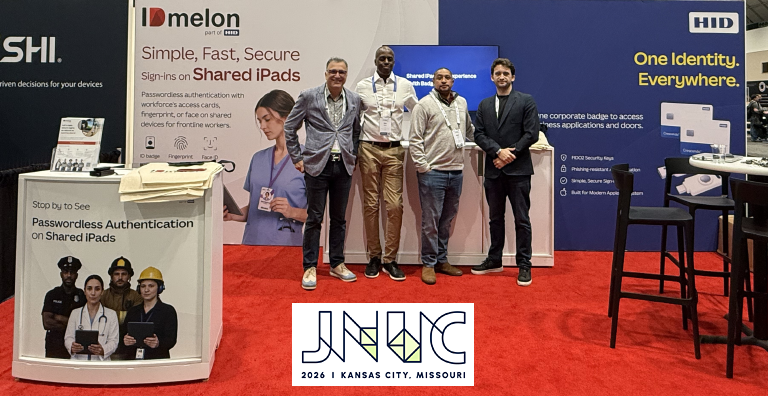
At the Jamf Nation User Conference (JNUC) 2026, I expected conversations about Apple device management. Instead, most discussions centered on a broader challenge: how organizations can deliver secure, passwordless authentication across shared devices, mixed operating systems and evolving workforce workflows.
After dozens of customer conversations, three themes emerged repeatedly: shared-device authentication, enterprise passkey adoption and identity strategies that extend beyond a single device ecosystem
Those conversations gave me a much clearer picture of where authentication and device management are heading.
Three Authentication Trends I Saw at JNUC 2026
1. Shared-device authentication is becoming a priority
2. Passkeys have entered the mainstream
3. Organizations need identity solutions that work across mixed-device environments
Shared Mobile Devices Are Becoming a Bigger Part of the Conversation
One of the strongest signals from JNUC was the level of interest in shared mobile devices. This was not a handful of isolated conversations. We consistently heard from organizations looking for better ways to manage authentication when a device is used by multiple people throughout the day.
Shared mobile devices are common in healthcare, retail, manufacturing, education and other industries where a tablet or mobile device may move between employees rather than be assigned to a single user.
The authentication requirements differ across these environments. Organizations still need strong security and individual accountability, but the experience also must work for someone who may sign in repeatedly during a shift. End-user convenience matters.
Managing the device is only part of the problem. Organizations also need an effective way to establish who is using it at any given moment, creating accountability through a reliable audit trail.
Customers Are Asking for Passkeys by Name
Another change was noticeable in the language customers used. A few years ago, most conversations began with broader requirements such as stronger authentication, multi-factor authentication or passwordless access. At JNUC, customers repeatedly asked specifically about passkeys.
That is a meaningful shift. FIDO2 (the Fast IDentity Online standard) and passkeys are no longer terminology limited to identity specialists. Customers increasingly understand the concept, have encountered it in their personal or professional lives, and expect passkeys to be part of their authentication strategy.
The conversation is changing. Less time is spent explaining why public-key-based authentication is useful, and more time is spent discussing how to make it work across the devices, applications, and workflows an organization already has.
An Apple-Focused Event Revealed a Very Mixed-Device Reality
JNUC is overwhelmingly focused on Apple, but almost every organization we spoke with was responsible for more than Apple devices. Windows systems came up frequently, as did Android.
Even organizations with substantial Apple deployments rarely operate in an Apple-only world. The same IT and security teams may be responsible for iPhones, iPads, Macs, Windows workstations, Chromebooks,and Android devices — some shared, others assigned to individual users.
An authentication strategy, therefore, cannot be designed around a single device type. People move between devices throughout the day. Their identity needs to move with them.
Software-Based and Device-Bound Authentication Solve Different Parts of the Same Problem
This is where the combination of IDmelon and the Crescendo product lines became particularly relevant. The interesting part was not simply that we had two authentication technologies to discuss. It was that they addressed different parts of the environments that customers were describing.
- IDmelon: Especially relevant to shared devices and mobile workflows, where organizations need to associate an individual user with a device that may not belong to them. It also enables passkey-based authentication via biometrics and mobile devices.
- Crescendo: A device-bound hardware credential that can follow the user between systems, including workstations and applications where a physical authenticator makes sense. Crescendo devices are also available in configurations validated under the Federal Information Processing Standards (FIPS), for environments with additional security or compliance requirements.
- Where they overlap: Both IDmelon and Crescendo Cards can help bring logical and physical access together, extending the same authentication strategy beyond applications and workstations to the physical environment.
For many customers, these use cases existed side by side. Someone might begin a workflow on a shared mobile device, move to a Windows workstation later in the day and access several applications along the way. The question is not which authentication method wins. It is about providing strong, familiar authentication across all those environments without creating unnecessary complexity for the user or the organization managing them.
That turned out to be one of the most productive conversations we had throughout the event.
Why These Trends Matter
Organizations are under pressure to reduce reliance on passwords, support mobile and frontline workers and maintain accountability across increasingly diverse device fleets. As device management and identity programs become more interconnected, authentication strategies must deliver both security and usability across shared and assigned devices.
What I Took Away From JNUC
The most interesting takeaway from JNUC wasn't about Apple device management. It was about identity.
Customers are increasingly looking beyond individual devices and asking how authentication can work consistently across shared devices, applications, operating systems and physical environments. As people move through all those touchpoints, their identity needs to move with them.
That's what made discussions around passkeys, shared-device authentication and broader access strategies so relevant throughout the event. It feels much more like a present-day requirement than a future trend.
Learn more about mobile access and converged authentication.