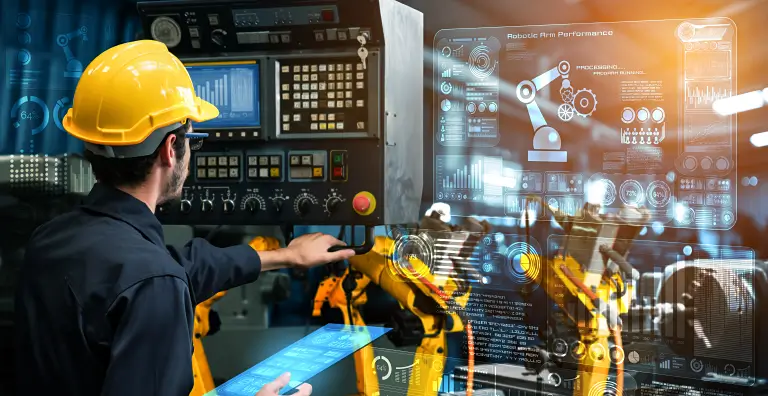
Manufacturing environments have always been built around precision, efficiency and uptime. But in recent years, a shift has been reshaping the factory floor. Connectivity and digitization are enabling smarter production, and they are also expanding the attack surface in ways many organizations are still working to fully understand.
Cybersecurity in manufacturing is no longer just an IT concern. It’s something that now touches every workstation, every shared terminal, every machine interface and every operator interaction. As production systems become more interconnected, the simple act of logging in or accessing equipment has become a critical security moment.
And in many ways, it’s one of the most overlooked.
Cyber Threats Are Moving to the Factory Floor
For years, cyberattacks were largely associated with corporate systems — email servers, databases and business applications. But manufacturing has become a high-value target in its own right.
Why? Because disruption in a production environment has immediate, tangible consequences. A successful attack doesn’t just compromise data; it can stop production lines, delay shipments, damage equipment or even create safety risks on the floor.
Modern factories rely on a growing ecosystem of connected assets — human-machine interfaces (HMIs), industrial PCs, shared operator stations and networked machinery. Each of these endpoints introduces new opportunities for access, and therefore new opportunities for exploitation.
What makes this particularly challenging is that these systems were often designed for availability and ease of use first, not security. As a result, traditional security models that work well in office environments don’t always translate cleanly to industrial settings.
The consequence is a widening gap between operational efficiency and secure access control.
Related: From HMI to Machine Panel: Securing Operator Access Across the Factory Floor >>
IT/OT Convergence Is Redefining Identity and Access
One of the biggest drivers of this change is the convergence of information technology (IT) and operational technology (OT). Where these systems once operated independently, they are now increasingly integrated into unified digital ecosystems.
On paper, this convergence is a major step forward. It enables better visibility, more efficient production planning and real-time data exchange between business and operational systems. But it also introduces a new complexity: identity now needs to function seamlessly across both worlds.
Operators aren’t just interacting with machines anymore; they’re interacting with systems that connect directly to enterprise networks, cloud platforms and centralized data repositories. A single log-in might unlock access to a workstation, a production line interface and downstream reporting tools.
That shift demands a more modern approach to authentication; one that doesn’t treat IT and OT as separate silos, but instead supports a unified identity experience across both. And it needs to do this without slowing down the people actually running production.
The Compliance Shift: Accountability at the Operator Level
As manufacturing environments become more digitized, regulatory expectations are evolving alongside them. Compliance frameworks are no longer focused only on the traceability of materials and production processes, but increasingly on the actions of individual users within those systems. This shift reflects a broader recognition that operational integrity depends not just on what is produced, but on who accessed systems along the way and how those systems were used.
In practice, this requires organizations to maintain a precise, verifiable record of user activity across production environments, specifically who accessed which system, when they accessed it and what actions they performed during that session. While this level of visibility is relatively straightforward in centralized IT environments, it becomes significantly more complex on the factory floor.
Despite these challenges, shared credentials remain common in many industrial settings because they are simple and operationally convenient. However, that convenience comes at a cost. When multiple individuals use the same log-in, accountability becomes blurred, audit trails lose precision and organizations lose the ability to confidently attribute actions to a specific operator. Over time, this creates gaps in visibility that can complicate compliance efforts, incident investigations and operational oversight.
As a result, the industry is moving toward a model of individual, identity-based authentication where every operator interaction is tied to a unique and verifiable identity.
Why Authentication Is Moving Closer to Machines
Traditionally, authentication was something that happened at the edges of systems; logging into a computer, accessing a network, or signing into an application. In modern manufacturing environments, that boundary has shifted much closer to the machines themselves.
Operators may need to authenticate directly at Human Machine Interfaces (HMIs), machine panels, safety gates or mobile devices on the factory floor. Access is no longer centralized at a single workstation; instead, it is distributed across the entire operational environment.
This creates a new challenge: authentication must now work in real-world industrial conditions.
That means systems need to account for gloves, fast-paced workflows, shift changes, shared physical spaces and the constant pressure to minimize downtime. If authentication becomes a bottleneck, operators will find workarounds. And in manufacturing, workarounds almost always introduce risk.
So the goal is no longer just secure access. It’s secure access that fits naturally into the flow of work.
The Limits of Password-Based Authentication in Manufacturing
Despite their widespread use in traditional IT environments, passwords are increasingly misaligned with the realities of the factory floor. Manufacturing environments operate under constant time pressure, with shared systems, rotating shifts and operators moving quickly between machines. In that kind of setting, authentication methods designed for static office use start to create more friction than value.
On the floor, that friction shows up immediately. Passwords take time to enter, are easy to forget under pressure and often require operators to pause work or remove protective equipment just to log in. While each interruption may seem minor on its own, they add up quickly in high-throughput environments where uptime and speed are key.
To keep production moving, operators often find workarounds. These behaviors are rarely intentional security violations — they are practical responses to operational constraints. But over time, they create real exposure. Common examples include:
- Shared logins used across multiple operators or shifts
- Passwords written down near workstations for convenience
- Credentials reused across different machines and systems
- Informal “quick access” practices that bypass proper authentication steps
Beyond behavior, the physical environment itself compounds the issue. Gloves, safety requirements, dust and industrial wear make traditional log-in methods harder to use reliably. In many cases, systems that are secure in theory become impractical in day-to-day operation.
The result is a constant tension between usability and security. And in most manufacturing environments, usability tends to win by default, often at the expense of strong, consistent authentication and clear operator accountability.
The Case for Passwordless, Operator-Centric Authentication
This is where passwordless authentication shifts the conversation. Instead of relying on something users must remember and manually enter, passwordless approaches use secure identity methods – such as credential cards or mobile-based authentication - that are faster, more reliable and tied directly to the individual operator.
The impact is twofold. First, it reduces friction for operators, allowing them to authenticate quickly and return to work without interruption. Second, it significantly improves security by removing one of the most commonly exploited weaknesses in industrial environments: shared or weak credentials.
But the value extends beyond individual interactions. As manufacturing systems continue to evolve, authentication cannot remain a patchwork of disconnected tools and local log-ins. What's needed is a unified identity layer that spans both IT and OT environments — one that ensures identity follows the operator wherever they go, across workstations, machines and production systems, without requiring separate credentials or fragmented access methods.
When that foundation is in place, security becomes less about isolated checkpoints and more about continuous assurance. Every interaction is authenticated, every action is traceable and every access point is governed by the same underlying framework. Authentication becomes part of the natural workflow rather than an obstacle to it; in manufacturing, that balance is essential.
Supporting a Unified Authentication Approach
Enabling secure and efficient operator authentication requires technologies that can function reliably across diverse manufacturing environments. Solutions such as HID's OMNIKEY Desktop Readers and Embedded Modules support a range of authentication methods, including smart cards, mobile credentials and passwordless authentication, helping organizations extend secure access practices across workstations, HMIs and other operational systems. By supporting open standards and multiple credential technologies, they can help manufacturers move toward a more consistent authentication experience while aligning security requirements with the practical realities of the factory floor.
Building a Secure Identity Layer Across the Factory
As manufacturing systems continue to evolve, authentication cannot remain a patchwork of disconnected tools and local log-ins. What’s needed is a unified identity layer that spans both IT and OT environments.
This layer ensures that identity follows the operator wherever they go — across workstations, machines and production systems — without requiring separate credentials or fragmented access methods.
When identity is embedded into the operational fabric of the factory, security becomes less about isolated checkpoints and more about continuous assurance. Every interaction is authenticated, every action is traceable and every access point is governed by the same underlying identity framework.
Just as importantly, this approach allows organizations to strengthen security without slowing down production. Instead of adding friction, authentication becomes part of the natural workflow. And in manufacturing, that balance is essential.
Conclusion
As organizations look to modernize their security posture, the focus must shift toward approaches that reflect the realities of industrial work: fast-paced, shared, distributed and highly operational.
The future of manufacturing security lies in authentication that is both strong and invisible, embedded directly into everyday workflows, without getting in the way of the work itself.
Contact HID to explore how OMNIKEY enables frictionless operator authentication that keeps production moving, providing fast, secure access wherever work happens on the factory floor.